

Dr. Mark Stengler, NMD, MS
NMN has become a familiar name on supplement shelves, marketed as a tool for slowing aging and boosting energy. Here’s a closer look at what it is and what the research shows.
What Is NMN, and Why Does It Matter?
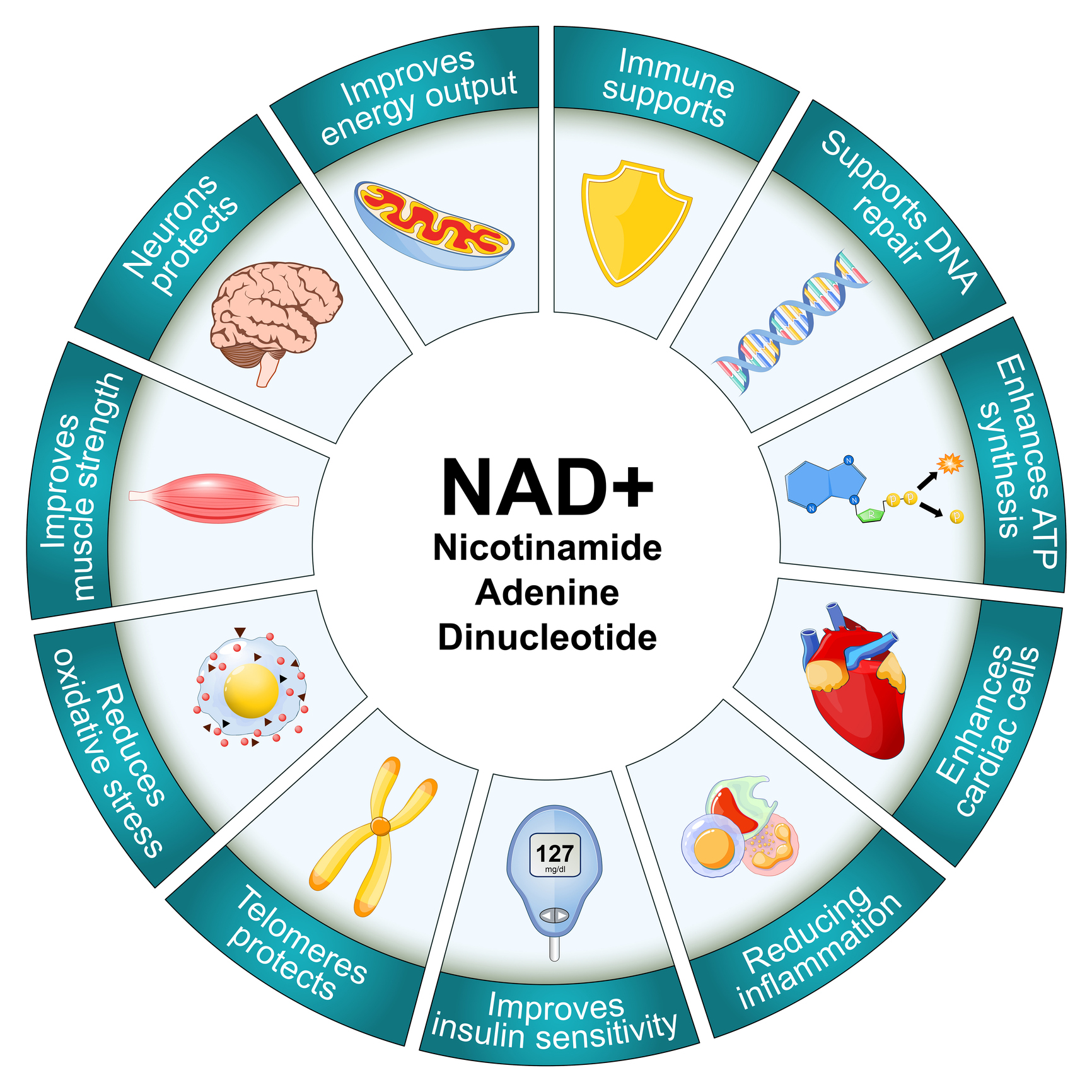
Nicotinamide mononucleotide (NMN) is a molecule the body uses to build nicotinamide adenine dinucleotide (NAD+), a coenzyme essential to nearly every cell. NAD+ powers cellular energy production and acts as a signaling molecule, regulating DNA repair, immune responses, and epigenetic changes — the chemical switches that turn genes on and off. The body can also make NAD+ from tryptophan, vitamin B3, and nicotinamide riboside (NR), but NMN converts into NAD+ rapidly once ingested.
NAD+ levels decline naturally with age, and that decline tracks with several hallmarks of aging. Human skin studies show a roughly 70 percent drop in NAD+ alongside rising oxidative DNA damage; liver tissue shows about a 30 percent loss between ages 45 and 60; and brain imaging shows a 10 to 25 percent decline from adolescence to old age. Because NAD+ supports energy metabolism, cardiovascular and neurological protection, DNA repair, and anti-inflammatory activity, NMN supplementation has become a key strategy for offsetting this decline.
From Mice to Humans
Much of the early excitement traces back to a landmark 2016 study in Cell Metabolism, where long-term NMN supplementation mitigated age-associated physiological decline in mice. That finding launched a wave of human research that has continued to build on it ever since.
What Human Studies Have Found
Human trials of NMN are growing steadily, and the results are encouraging. A review of ten studies and 437 patients, with an average age of 58 and average follow-up of 9.6 weeks, found that NMN doses ranging from 150 to 1,200 milligrams daily were well tolerated, with no serious adverse effects.
In a 12-week, randomized, double-blind, placebo-controlled trial of 108 Japanese adults over age 75, 250 milligrams of NMN daily produced significant improvements in physical performance, measured by a five-times sit-to-stand test, along with reduced daytime drowsiness and better sleep duration and quality.
A six-week trial of 48 recreationally trained runners, randomized into four groups receiving a placebo or 300, 600, or 1,200 milligrams of NMN daily while training five to six times a week, found that the 600 and 1,200 milligram doses increased aerobic capacity during exercise — an effect researchers attributed to improved oxygen utilization in skeletal muscle.
Together, this research positions NAD+ precursors like NMN as a meaningful tool for supporting energy metabolism, physical performance, and healthy aging.
A Skin-Health Pairing: Red Orange Complex
Some NMN formulations are paired with Red Orange Complex™, an extract from pigmented Sicilian blood oranges rich in anthocyanins, hydroxycinnamic acids, flavanones, and vitamin C. In a 2022 trial of 110 adults aged 35 to 55 with visible skin aging, 100 milligrams daily improved the skin’s response to UV exposure, increased antioxidant capacity, and boosted moisture, elasticity, and radiance while reducing water loss, dark spots, and wrinkle depth.
A second 2022 trial in 60 older adults found that 100 milligrams daily raised a key antioxidant marker (the GSH/GSSG ratio) by 22 percent at two weeks and 89 percent at eight weeks, while lowering an inflammatory marker (TNF-alpha) by 2.5 percent — alongside reported improvements in overall well-being.
The Bottom Line
NAD+ decline is a measurable part of human aging, and NMN offers a direct, biologically effective way to support it. Human studies show NMN is well tolerated and delivers real benefits for physical performance, sleep, and exercise capacity, while Red Orange Complex adds proven support for skin health and antioxidant defense. Together, these compounds represent some of the most promising tools available today for supporting healthy, active aging.
References
Alegre, G. F. S., & Pastore, G. M. (2023). NAD+ precursors nicotinamide mononucleotide (NMN) and nicotinamide riboside (NR): Potential dietary contribution to health. Current Nutrition Reports, 12, 445–464. https://doi.org/10.1007/s13668-023-00475-y
Benjamin, C., & Crews, R. (2024). Nicotinamide mononucleotide supplementation: Understanding metabolic variability and clinical implications. Metabolites, 14(6), 341. https://doi.org/10.3390/metabo14060341
Cercillieux, A., Ciarlo, E., & Canto, C. (2022). Balancing NAD+ deficits with nicotinamide riboside: Therapeutic possibilities and limitations. Cellular and Molecular Life Sciences, 79, 463. https://doi.org/10.1007/s00018-022-04499-5
Liao, G., Xie, Y., Peng, H., et al. (2024). Advancements in NMN biotherapy and research updates in the field of digestive system diseases. Journal of Translational Medicine, 22, 805. https://doi.org/10.1186/s12967-024-05614-9
Mills, K. F., Yoshida, S., Stein, L. R., Grozio, A., Kubota, S., Sasaki, Y., Redpath, P., Migaud, M. E., Apte, R. S., Uchida, K., Yoshino, J., & Imai, S. I. (2016). Long-term administration of nicotinamide mononucleotide mitigates age-associated physiological decline in mice. Cell Metabolism, 24(6), 795–806. https://doi.org/10.1016/j.cmet.2016.09.013
Nadeeshani, H., Li, J., Ying, T., Zhang, B., & Lu, J. (2021). Nicotinamide mononucleotide (NMN) as an anti-aging health product—Promises and safety concerns. Journal of Advanced Research, 37, 267–278. https://doi.org/10.1016/j.jare.2021.08.003